In the Part I, we looked at the basic controls of a motorcycle, safety gear, and being a passenger. Now, let's take a look at what to think about when it comes time to buy your own bike.
Safety cannot be over emphasized. Before we get into the fun stuff of looking at different bikes, let's remember that when things go bad at 60mph, the body is going to be punished. Motorcycles aren't cars. When you lose attention here or find yourself beyond the limits of your skill or machine, the price is far greater than simply tapping the breaks or steering into the spin. Make a mistake here and the odds of going down are much greater than those of a mistake causing you to wreck an automobile. Keep sober, keep alert, and realize that you are taking part in a sport defined by managed risk. The greater benefits are directly a result of those things that make the activity a greater risk. If you walk up to a bike and your little voice says, “not today,” walk away and do something else that day.
 The other thing we have to address is training. Simply put, get some. The Motorcycle Safety Foundation puts on weekend classes all over the country. They are well worth the cost. Second, realize that learning and becoming skilled on a bike isn't something you are going to learn in a weekend and a few months of practice like you did driving a car. There are so many variables involved that you will be adding to your skill level over the years. Don't get frustrated early on if you can't do something, and don't get overly cocky thinking you know everything after a weekend class.
Alright, there's no sense beating those drums anymore. You either get it and respect the damage asphalt can do to skin and what a Peterbuilt can do to your skull or you don't. Let's get to the fun stuff.
You've got some safety gear, you've taken your course, and you have a wad of cash just burning a hole in your pocket. You want a bike so bad you can taste it. But, you don't want to buy the “wrong” bike and you want to get your money's worth. The question always asked is, “what bike should I buy?”
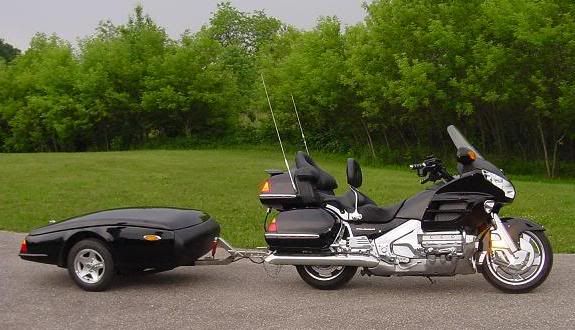 Honda Gold Wing, no doubt, anything else would be stupid. Actually, it's that answer that is stupid (I jest, I do like the Gold Wing, but someone shoot me if I ever put a trailer on a motorcycle). It's stupid because there is no one answer to “what bike?” It all depends on your size, age, maturity, amount of money to spend, confidence level, and what you want to do with it.
When you start talking to people about specific motorcycles, you will hear them throw descriptive numbers about. “I had a 250,” “that was a fast 750,” “I rode a 1200 across country.” What they are referring to is the engine size which is calculated by the combined cubic centimeters displaced by the pistons. That leaves a lot of details on the table, but engine size is much more significant in a lightweight vehicle such as a bike than they are in a passenger car. The reference will give you a basic idea about the size, weight, and power of the bike in question. This system is a throwback to the days when there weren't different styles of motorcycles, there were just motorcycles and the habit has remained.
 Today, there are all dirt bikes, street bikes, and bikes that blur the lines between the two. For the sake of this article, and because it's what I know, we'll assume you want to ride on the street. With street bikes, there are basic types such as cruisers (Harley-style), sport bikes (the fastest and best handling), tour bikes (carry what you and your gear for days at a time), standards (basic bike – motor, two wheels), and dual sports (the mix of a street bike and off-road bikes). Of course, there are blends and hybrids and all sort of bikes to do things you have probably never even considered.
Buying a bike is a very personal thing that is as much a mix of heart and desire as it is mind and logic. If you want a particular bike, dream about it, can't think of anything else while you are at work, you're probably going to be fairly happy with it. There are a few different approaches to finding that steel vixen that will insist on finding a home in your garage.
There is a very common train of thought that says buy something used and small, learn on it for six months or a year, and sell it when your skills outgrow it. A lot of people have gone that route and have been very happy to do so. Many beginning riders will lay down their first bike, so why abuse a new bike and throw money on something you are going to scuff up? And, after all the lust, desire, and training, you might spend three months dodging Volvos, cleaning bugs off your helmet, and getting rained on and say to yourself “nope, this isn't for me after all.” If you find yourself at all hesitant, buying the cheap, used, small bike saves you from investing too much money on something you won't end up using.
If that sounds like an approach that works for you, a few bikes over the years are constant standouts in this category. The Honda Rebel 250 looks like a Harley that got hit by a shrink ray. The things run forever and you will probably be able to sell it for what you have into it. It is lightweight and easy for almost anyone to sit on and put their feet flat on the ground. Where the Rebel is a cruiser, the Yamaha TW200 is an odd little dual purpose bike. It sits low and has a very reliable motor; it's big balloon type tires roll over anything, and are great little bikes for exploring a campground or your neighborhood.

 Moving up in size, the Suzuki GS500F is a great commuter for those wanting a big more punch than a 250cc will deliver. The same can be said of it's major competition, the Kawasaki Ning 500R (formerly the EX500). Both wear the clothes of a sport bike but are really standards – just good, solid bikes that will take the day to day grind.
 Really, any of the smaller Japanese bikes should be fairly inexpensive and will suit you well for learning. Stay bellow a 500cc motor and your insurance should stay at paltry levels. Keep that same 500cc ceiling and you can be sure to not have too much engine.
In the mid-size cruiser segment, the Star V-Stars by Yamaha are very popular – reliable, look good, sit low, and have a no-maintenance shaft drive. You rarely see the “cool” people talking about them on different forums, but you see a heck of a lot of the bikes during morning rush hour and in parking lots everywhere. The guys who actually use their bikes seem to like them a lot and the Star branded bikes are probably behind only BMW & Harley-Davidson for the number of die hard fanatics who don't want to ride anything else. The endorsement of the road speaks more loudly than anything in print – including my thoughts here – ever should.
 Is there such a thing as “too much engine?” You wouldn't think so unless you have ridden the crop of modern sport bikes. If there's one thing I will recommend the new bike buyer, it's to NOT buy a hyper-performance sport bike. Don't get me wrong, I think a person should buy what they like, but I encourage those with the go-fast bug to learn a bit before completely giving in to their speed lust. Most people think that a sport bike is the two-wheeled equivalent of a sports car. To a point that is true, but it doesn't tell the entire story. While a sports car is fast and “sporty,” it's a far cry from a race car. That isn't the way it works in the motorcycle world. The sport bike sitting on the dealer's showroom floor today is a true race bike and not very different from what the top riders were using on the track a few years ago. The power of those bikes is simply unreal. The bikes that aren't of the race bike family are sometimes left out because even racers don't use engines that big. Think of them as your very own cruise missile on wheels. Even the small 600cc sport bikes will blow the mirrors off my 1,450cc Harley. And that is why the old way of referring to bikes by engine displacement can be deceptive.
 This doesn't mean the person who wants to go out and carve the corners is caught in a Catch 22 of “I have to learn before I can do, but how can I learn if I never do?” There are plenty of bikes that combine more than enough horsepower in packages that are friendly and handle well. The shining example in this category is the Suzuki SV650S (the "S" is for the fairing, there is a "naked" model, too.) It's mid-size, v-twin motor pushes the bike along with a predictable power curve not nearly as sensitive as a high-strung repli-racer. Along the same lines but with a four cylinder mill, the Yamaha FZ6 is sometimes referred to as a sport bike, sometimes as a “standard with a fairing” (one of those hybrids, again) and is nothing but loved by it's owners.
 In this mid-sized engine group is one of my favorite bikes, the Kawasaki KLR650. It's cheap, it's ugly, it's slow, it's reliable, and you can ride around the world on it. A “thumper,” or single cylinder motor, this bike has been around since the 1980's and received it's first significant, evolutionary (but not revolutionary) make over as an early release 2008. This bike is not for someone who wants to look good going down the road, it's for those who want to go down any road they look. The over sized gas tank and fuel sipping habits let a rider cover a lot of remote country between fill-ups. You just have to respect a bike like that.
  We started with the idea of “small, used, and cheap” and have moved up the ladder to mid-sized bikes for people who want a bit more power. By no means have we covered the entire gambit, but we've given a good bit of info to think about and a few bikes to Google in order to see how they hit your fancy. Size, the engine and physical dimension of the bike, will be a factor, but you won't know if you and the bike fit each other until you get into a showroom and sit on it. Don't be surprised if the dealer won't let you go for a test ride. Would you let a rank beginner ride your bike?
Bikes are more maintenance intensive than the hands-off cars we are used to today. Some people get worked up over one type of widget being more reliable or requiring less maintenance than some other type of widget. My advice at this stage is to ignore all of that. If you stay away from the high-strung sport bikes and anything Italian, maintenance won't be bad and you'll figure it out for whatever you get. Once you have more experience, you can decide what you are willing to do and what you'd rather not have to mess with.
If you are an older rider entering the sport or feel you have the maturity to control your throttle hand, I would still recommend against jumping right onto a hard core sport bike. Riding one safely goes beyond maturity and self-control. They require a large dose of experience to keep from getting in over your head. But, if you want that Honda Gold Wing so you and your wife can take off for a month and see the country, then don't feel as if you should stop yourself (just promise me you won't pull a trailer.) Lusted after that big Harley since your uncle had one? Knock yourself out. Just remember, these are bigger investments and bigger bikes - they are easier to drop and more expensive to fix than that used, small, beater bike. If money isn't an object, then don't worry about it, and we should really get to know each other better.
In the end, you have to like and want what you buy for it to be worth your money. Decide what you think you are going to want to do, look at the bikes that will do it, cross reference with your budget, and take to the open road. This is a sport about emotion and desire. If you deny yourself those basic elements, then you're shorting yourself before you even hit the starter button on your new bike.
What do I wish I had known when I started? I wish I had known how great it would be so that I could have started even earlier. Now get out there and ride!